
1 tsp Fish Oil per 20 lb: Dog Hip Dysplasia Supplements That Work

Yes, certain supplements can meaningfully ease hip dysplasia symptoms in dogs, but none of them fix the underlying joint malformation. Omega-3 fish oil has the strongest evidence behind it, while glucosamine, chondroitin, and MSM offer possible symptom relief for some dogs. Start any supplement only after talking to your veterinarian, and pair it with weight control and controlled exercise since those two factors do more for comfort than any pill or chew alone.
TL;DR:
- Omega-3 fish oil shows the strongest evidence for alleviating inflammation and stiffness in dogs with hip dysplasia, with recommended doses around 1 teaspoon per 20 pounds of body weight.
- Combining glucosamine, chondroitin, and MSM can provide symptom relief for some dogs, but results vary depending on dose, quality, and individual response.
- Supplements are most effective when paired with weight control and low-impact exercise, and they support, not replace, veterinary treatments like NSAIDs or physical therapy.
- A structured recheck at four to six weeks helps determine if the supplement regimen improves mobility, morning stiffness, or pain signs before making adjustments.
- Ensuring supplements list specific EPA and DHA amounts, are veterinary formulated, and are easy to administer increases the likelihood of positive outcomes and consistent use.
Table of Contents
- What Supplements Actually Help With Hip Dysplasia in Dogs?
- How Do Supplements Fit Into a Full Treatment Plan?
- What Is the Right Fish Oil Dose for a Dog’s Joints?
- How Long Until You See Improvement From Joint Supplements?
- How Do You Choose a Good Hip Dysplasia Supplement?
- What Does a Practical Supplement Plan Look Like by Severity?
- Where Healthy Aging Chews Fit Into This Guide’s Criteria
- An Editorial Take on Getting This Right
- Get Started With Petgev’s Healthy Aging Chews
- Sources
- FAQ
What Supplements Actually Help With Hip Dysplasia in Dogs?
Hip dysplasia itself is a structural problem: the ball and socket of the hip joint don’t fit together properly, and no chew or oil will reshape that joint. What supplements target is the secondary damage, the inflammation, cartilage wear, and joint fluid breakdown that follows years of an unstable hip grinding against itself. Understanding that distinction matters because it resets expectations before you spend money on the wrong thing.
Glucosamine and chondroitin are the classic pairing, and they’ve been around long enough that most owners have heard of them from human joint supplements too. The evidence in dogs is mixed. Some dogs show noticeably better mobility within a few weeks; others show no measurable change. The theory is that glucosamine supplies raw material for cartilage repair while chondroitin blocks some of the enzymes that break cartilage down, but results vary enough by dog, dose, and product quality that no vet will promise it will work.
MSM (methylsulfonylmethane) rarely stands alone. It shows up as a sulfur-donor ingredient added to glucosamine and chondroitin blends, and its role is mostly anti-inflammatory support rather than structural repair. Think of it as a supporting player, not the headline ingredient.
Omega-3 fatty acids (EPA and DHA) have the most consistent research behind them of anything on this list, which is why Cornell University’s College of Veterinary Medicine treats omega-3s as the cornerstone of joint supplementation rather than an optional add-on. EPA and DHA work by shifting the body’s inflammatory pathways toward less-inflammatory compounds, which can translate into less morning stiffness and easier movement after rest.
Green-lipped mussel and collagen ingredients show up in premium blends and marketing copy a lot these days. Green-lipped mussel contains its own natural omega-3s plus glycosaminoglycans, so it overlaps with fish oil’s mechanism rather than adding something entirely new. Collagen, meanwhile, gets broken down into amino acids during digestion just like any other protein, so how much of it actually reaches the joint as intact collagen is genuinely unclear.
When you’re comparing multi-ingredient “joint blends,” here’s what actually separates a useful product from a marketing exercise:
- Check the milligram amounts, not just the ingredient list. A product can legally list “omega-3 fatty acids” as an ingredient while including a dose too small to do anything.
- Watch for proprietary blends. If a label lists a combined weight for five ingredients instead of individual amounts, you can’t tell how much of anything you’re actually giving.
- Look for the active form. Glucosamine hydrochloride and glucosamine sulfate are not identical in absorption, and cheap products sometimes substitute the less-studied form.
- Ask whether dosing scales to your dog’s weight. A 90-pound Labrador and a 25-pound Corgi mix need very different amounts, and a one-size chew rarely gets both right.
The honest takeaway: no single ingredient reverses dysplasia, but combining a few evidence-backed ones, dosed correctly, adds up to real symptom relief for a lot of dogs.
How Do Supplements Fit Into a Full Treatment Plan?
Supplements work best as one piece of a bigger plan, never as the whole strategy. Cornell’s guidance on joint supplements frames them explicitly as adjunctive, meaning they support other treatments rather than replace them.
Weight management is the foundation, and it’s not close. A 2015 review of canine hip dysplasia management found that a 25% dietary restriction in Labrador Retrievers genetically predisposed to hip dysplasia delayed the onset and reduced the severity of osteoarthritis compared to dogs fed freely. That’s not a small effect from a supplement bottle; that’s a change in feeding that altered the disease course over years. If your dog is carrying extra weight, that’s the first lever to pull, before you even open a jar of chews.
Controlled exercise comes next. Dogs with hip dysplasia generally do better with steady, low-impact movement, think leash walks and swimming, rather than sprinting, jumping off furniture, or rough play that jolts the joint. Consistency matters more than intensity here.
Veterinary treatments typically layered alongside supplements include:
- NSAIDs (like carprofen or meloxicam) for flare-ups and acute pain control.
- Gabapentin, sometimes added when there’s a nerve-pain or chronic pain component.
- Chondroprotectant injections such as Adequan or Cartrophen, which work through a different mechanism than oral supplements and are prescribed by a veterinarian.
- Physical therapy or hydrotherapy, which builds supporting muscle around an unstable joint.
According to VCA Animal Hospitals, many dogs benefit from combining these approaches rather than relying on any single treatment, and the specific mix is individualized based on the dog’s age, severity, and response to earlier treatments.
For dogs with more advanced disease, your vet may raise the question of surgery, ranging from a femoral head osteotomy in smaller dogs to a total hip replacement in larger ones. Supplements don’t replace that conversation, but they can support recovery afterward by helping manage inflammation as the dog rebuilds strength and range of motion during rehab.
Braces and mobility aids are worth a mention too. A supportive hip brace, non-slip flooring, ramps instead of stairs, and simple traction booties often do more for day-to-day comfort than owners expect, and they work well alongside whatever supplement regimen you land on.
What Is the Right Fish Oil Dose for a Dog’s Joints?
Here’s the number to write down: Cornell recommends roughly 1 teaspoon of fish oil per 20 pounds of a dog’s ideal body weight as a general benchmark for joint support, according to its guidance on joint supplements. For a 60-pound dog, that works out to roughly a tablespoon a day, though your vet may adjust based on your dog’s specific EPA and DHA needs and any other medications involved.

That benchmark matters because most joint chews don’t come close to it. A chew has to stay dry and shelf-stable, and liquid fish oil doesn’t play well with that format. So a chew might list “omega-3 fatty acids” on the label while delivering a fraction of a therapeutic dose. Cornell’s guidance notes that owners often need to add a separate fish oil product on top of a chew to reach an amount that actually changes inflammation, rather than assuming the chew alone covers it.
Pro Tip: If your dog’s chew doesn’t list a specific EPA+DHA milligram amount on the label, assume it’s a maintenance dose at best, not a therapeutic one, and ask your vet whether a liquid fish oil supplement should be added.
Safety is where fish oil earns a little caution. It’s generally well tolerated, but at higher doses it can cause:
- Loose stools or GI upset, especially if introduced too quickly.
- Increased bleeding risk, because omega-3s have a mild blood-thinning effect.
- Interaction concerns with NSAIDs and anticoagulant medications, which is why your vet needs to know every supplement you’re giving before surgery or a new prescription.
That bleeding-risk interaction is genuinely worth flagging with your vet if your dog is already on an NSAID for hip pain or scheduled for any surgical procedure, including a dental cleaning. It’s a real consideration, not a theoretical one.
The practical way to introduce fish oil is gradually. Start at a quarter or half the target dose for the first week, watch stool quality, and increase from there. If you see vomiting, unusually dark or tarry stool, or excessive lethargy, stop and call your vet rather than pushing through it.
Glucosamine and chondroitin carry a gentler safety profile overall, with mild GI upset being the main complaint. MSM is generally well tolerated too. None of these commonly interact with prescription joint medications the way fish oil can, but any supplement change is worth mentioning at your dog’s next checkup, if not sooner.
How Long Until You See Improvement From Joint Supplements?
Give it four to six weeks before judging whether a supplement is working. That window shows up consistently in veterinary discussions of joint supplements for arthritis and hip dysplasia, and it lines up with how long omega-3s and glucosamine typically take to build up and shift inflammatory activity in the joint. Expecting results in a week sets you up to quit on something that would have worked.
Here’s how to actually track change instead of guessing:
- Establish a baseline before you start. Note how long it takes your dog to stand up after resting, whether they hesitate before stairs, and how far they’ll walk before slowing down.
- Time a familiar walk weekly. A stopwatch on the same route tells you more than a vague sense that “he seems better.”
- Watch morning stiffness specifically. Hip dysplasia symptoms are often worst first thing in the morning; improvement there is one of the clearer early signals.
- Use a simple mobility scale. Rate sit-to-stand, stairs, and jumping on a 1 to 5 scale weekly so small changes don’t get lost in day-to-day noise.
- Schedule a vet recheck at 4 to 8 weeks. A structured follow-up with baseline measures and a set recheck window gives you and your vet an actual basis for deciding whether to continue, adjust the dose, or try something else.
Watch for red flags that mean it’s time to escalate rather than wait out the six weeks: sudden reluctance to bear weight at all, visible swelling, yelping when touched near the hip, or a rapid decline after previously stable mobility. Any of those warrants a vet visit sooner, not a longer trial of supplements.
How Do You Choose a Good Hip Dysplasia Supplement?
The label tells you almost everything you need to know if you read it correctly. Start with the actual EPA and DHA milligram amounts per serving, not the word “omega-3” sitting on the ingredient panel. A product can technically contain fish oil and still deliver a dose too small to matter. If a label won’t tell you the EPA+DHA content in milligrams, that’s a reason to look elsewhere.
Veterinary formulation is worth paying for. Products developed with veterinary input tend to use dosing that’s grounded in actual clinical guidance rather than a formula copied from a human supplement and rebranded for pets. That doesn’t mean every vet-formulated product is automatically right for your dog, but it’s a meaningfully better starting point than a generic label with no clinical input behind it.
Form factor changes what you can actually achieve:
- Liquid fish oil allows for real therapeutic dosing, since you can scale the amount to your dog’s exact weight without stuffing them full of chews.
- Chews and soft treats are far easier to administer daily, especially for multiple-dog households or picky eaters, but they often cap out at a maintenance dose rather than a therapeutic one, as covered in the dosing section above.
- Powders mixed into food split the difference: better dosing flexibility than a chew, less mess than liquid oil, though palatability varies by dog.
Third-party testing is the detail most owners skip and shouldn’t. A product tested by an independent lab for contaminants and label accuracy gives you some assurance that what’s on the bottle matches what’s actually inside it. Supplements aren’t regulated with the same rigor as pharmaceuticals, so this step substitutes for oversight that otherwise doesn’t exist.
Be skeptical of anything promising to “cure,” “reverse,” or “eliminate” hip dysplasia. No supplement rewrites the shape of a joint. Language that strong is a marketing claim, not a clinical one, and it’s worth treating as a red flag rather than a selling point.
Pro Tip: Keep a photo of your current supplement’s ingredient panel on your phone. When you’re comparing products at the store or online, you can check EPA+DHA amounts side by side instead of relying on memory or brand reputation alone.
Finally, consider how many separate products you’re realistically going to give every day without missing doses. A perfectly dosed regimen that requires four different bottles and gets skipped twice a week does less for your dog than a slightly simpler one you actually stick with.
What Does a Practical Supplement Plan Look Like by Severity?
These are starting points to bring to your veterinarian, not a substitute for their exam and specific recommendations, since severity, age, weight, and other health conditions all change what’s appropriate for your dog.
-
Mild symptoms (occasional stiffness, no obvious limping): A daily omega-3 supplement at a maintenance dose, combined with a joint chew containing glucosamine and chondroitin, is often a reasonable entry point. Pair it with consistent, low-impact exercise and confirm your dog’s weight sits at or near ideal.
-
Moderate symptoms (regular stiffness, reluctance on stairs, visible discomfort after activity): This is where hitting the therapeutic fish oil benchmark, roughly 1 teaspoon per 20 pounds of ideal body weight, starts to matter more, alongside a chondroprotectant-style supplement and a structured, vet-guided rehab or physical therapy program. Traction aids around the house and a stricter exercise routine usually earn their keep at this stage too.
-
Severe symptoms (persistent pain, significant mobility loss, or poor response to supplements alone): Supplements shift from primary strategy to supporting role here. Expect this tier to involve prescribed NSAID therapy, possibly chondroprotectant injections like Adequan, and a genuine conversation with your vet about surgical options if conservative management isn’t holding the line. Supplements can still help manage inflammation and support recovery around whatever medical or surgical treatment your vet recommends.
Introduce any new supplement gradually rather than starting several at once, both to reduce GI upset and so you can actually tell which ingredient is doing the work if your dog improves. Book a follow-up at 4 to 8 weeks regardless of severity tier. That checkpoint is where you and your vet decide whether to continue, adjust dosing, or escalate to a different approach.
Where Healthy Aging Chews Fit Into This Guide’s Criteria
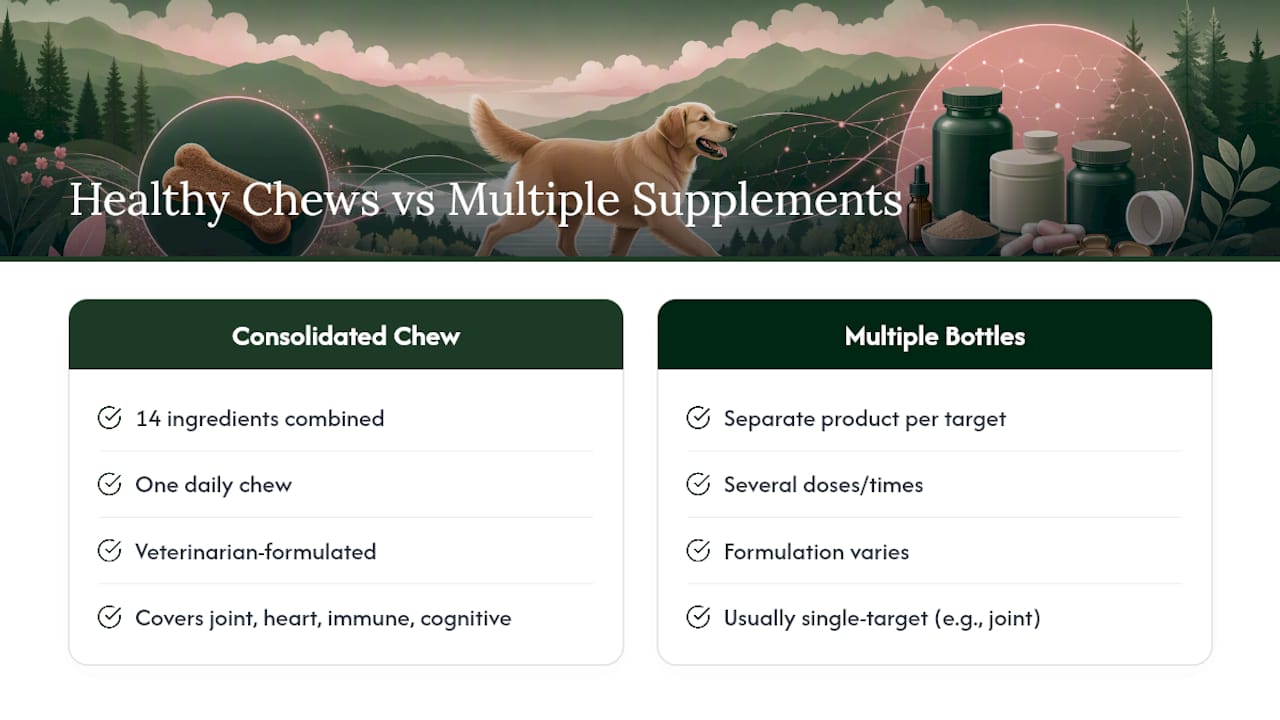
Everything above points to a few practical asks: know your actual EPA and DHA numbers, favor veterinary formulation, and don’t juggle six separate bottles if you can help it. That last point is where a lot of owners quietly give up on a good regimen, not because the ingredients were wrong, but because remembering five different supplements at five different times of day just doesn’t survive real life.
Petgev’s Healthy Aging Chews were built around that exact problem. The chews are veterinarian-formulated and combine 14 ingredients into one daily treat, covering joint mobility alongside heart, immune, and cognitive support rather than isolating joint care as a separate product to manage. For an owner already tracking a hip dysplasia regimen, consolidating several single-purpose supplements into one consistent daily chew removes a real point of failure: the missed dose, the forgotten bottle, the second product that never gets picked up when the first one runs out.
The formulation rationale, including how the ingredient list was assembled, is laid out on Petgev’s science page for anyone who wants the reasoning behind the recipe rather than just the ingredient panel.
None of that replaces the dosing conversation from earlier in this guide. If your dog needs a therapeutic omega-3 dose to manage moderate or severe symptoms, confirm with your veterinarian whether Healthy Aging Chews cover that need on their own or whether a separate fish oil product should be added alongside it. A vet-formulated chew is a strong foundation, but your dog’s specific severity and weight determine the final dose, not the label alone.
An Editorial Take on Getting This Right
The supplement aisle rewards people who want a simple answer, and hip dysplasia doesn’t offer one. What actually moves the needle, based on everything the research supports, is boring: keep the dog lean, keep the exercise controlled and consistent, and treat supplements as one supporting piece rather than the whole plan. Owners who skip straight to the fanciest joint chew while ignoring the extra ten pounds their dog is carrying are working against themselves before they’ve started.
I’d also push back gently on the instinct to stack five different products at once because more feels like it must be better. It usually just means you can’t tell what’s working, and you’re more likely to miss a dose across all five than you would with one consistent routine. Start with your vet, get a real baseline, and give whatever you choose the full four to six weeks before deciding it isn’t working.
— Eden
Get Started With Petgev’s Healthy Aging Chews
Petgev’s Healthy Aging Chews pack 14 vet-formulated ingredients into a single daily treat, built to cover joint mobility, heart health, immune function, and more without juggling separate bottles for each concern.
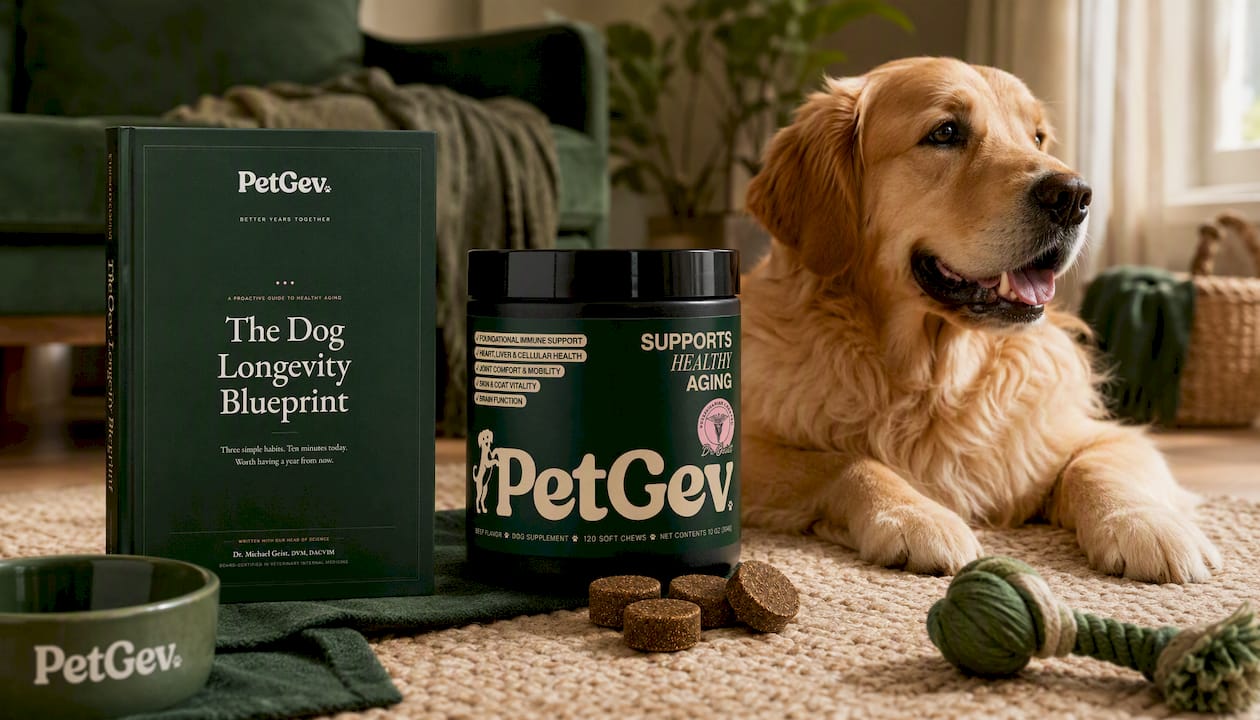
Instead of stacking a joint chew, a fish oil bottle, and a handful of other single-purpose supplements, this approach consolidates that routine into one chew your dog will actually look forward to. For a broader roadmap for supporting your dog through the years ahead, the Dog Longevity Blueprint lays out a longer-term health planning approach that pairs well with daily supplementation. As with anything covered in this guide, confirm dosing and ingredient suitability with your veterinarian before starting, especially if your dog is already on prescription joint medication. Visit Petgev to check current options and start a subscription that keeps your dog’s daily routine simple.
Sources
This guide draws on veterinary and peer-reviewed sources rather than marketing claims:
- How joint supplements can help with orthopedic conditions | Cornell University College of Veterinary Medicine
- Canine hip dysplasia management review (PMC)
- Hip Dysplasia in Dogs | VCA Animal Hospitals
For additional practical pet health discussion, Animal Care of Hobe Sound’s blog covers everyday veterinary topics worth a read.
FAQ
What helps dogs with hip dysplasia naturally?
Weight management and controlled, low-impact exercise do more for hip dysplasia symptoms than any single natural remedy, according to research on predisposed Labrador Retrievers. Omega-3 fish oil is the natural supplement with the strongest supporting evidence alongside those lifestyle changes.
What supplements can help with hip dysplasia?
Omega-3 fatty acids (EPA and DHA) have the most consistent evidence, according to Cornell’s veterinary guidance, with glucosamine, chondroitin, and MSM offering possible additional symptom relief. Vet-formulated chews like Petgev’s Healthy Aging Chews combine several of these into one daily product.
What medicine can I give my dog for hip dysplasia?
Veterinarians commonly prescribe NSAIDs like carprofen or meloxicam for pain and inflammation, sometimes alongside gabapentin or chondroprotectant injections such as Adequan, according to VCA Animal Hospitals. Any medication should come from your vet, since dosing and drug interactions with supplements matter here.
What worsens hip dysplasia in dogs?
Excess body weight is the single biggest aggravating factor, with research showing that dietary restriction delayed osteoarthritis onset in predisposed dogs. High-impact activity like jumping, rough play, and slippery flooring also accelerates joint wear and increases pain flare-ups.
