
Senior Dogs: One Daily Chew That Boosts Mobility Exercises in 8 Weeks

A veterinarian-formulated daily chew can genuinely help an aging dog move, sit, and climb stairs more comfortably when it contains ingredients backed by clinical research, and most owners see changes within 4 to 12 weeks of consistent use. Consider daily chews designed to support multiple aspects of senior dog health in a single treat instead of juggling several separate bottles each day.
TL;DR:
- Clinical research supports ingredients like UC-II, Boswellia, omega-3s, eggshell membrane, and curcumin derivatives for early mobility improvements, typically visible within 4 to 8 weeks.
- Significant objective benefits tend to emerge between 8 and 12 weeks of consistent use, with owner observations often noticing comfort improvements before measurable changes.
- Owners should establish a baseline, follow a fixed start time, and combine supplementation with gentle activity and weight control to optimize results.
- Dogs with mild to moderate osteoarthritis, extra weight, or advanced age benefit most, but dogs with shellfish allergies or on medications should consult a veterinarian before starting.
- The strongest outcomes come from a combined approach of nutritional support and movement, with patience and consistent use being key to noticeable improvements.
Table of Contents
- What Are Dog Mobility Exercises in the Context of Nutrition?
- What Does the Research Say About Mobility Chew Ingredients?
- How Do You Start a Mobility Chew the Right Way?
- Who Should Use a Mobility Chew, and Who Should Check With a Vet First?
- Why Petgev Built a Multi-Ingredient Chew Instead of a Single Supplement
- What Types of Movement Pair Well With a Mobility Chew?
- How Do You Know If Your Dog’s Mobility Needs Help?
- What Warning Signs Mean You Should Stop and Reassess?
- Weight and Lifestyle Changes That Multiply a Chew’s Effect
- What the Evidence Actually Supports, and Where Owners Get It Wrong
- How to Try Petgev’s Chews Without Overcomplicating It
- Sources
- FAQ
What Are Dog Mobility Exercises in the Context of Nutrition?
When people search “dog mobility exercises,” they’re often picturing stretches or physical therapy routines. This article covers a different but closely related category: nutrition-based mobility support, specifically the daily chews and supplements formulated to help joints move better from the inside out. Think of it as the biochemical half of mobility care, working alongside movement rather than replacing it.
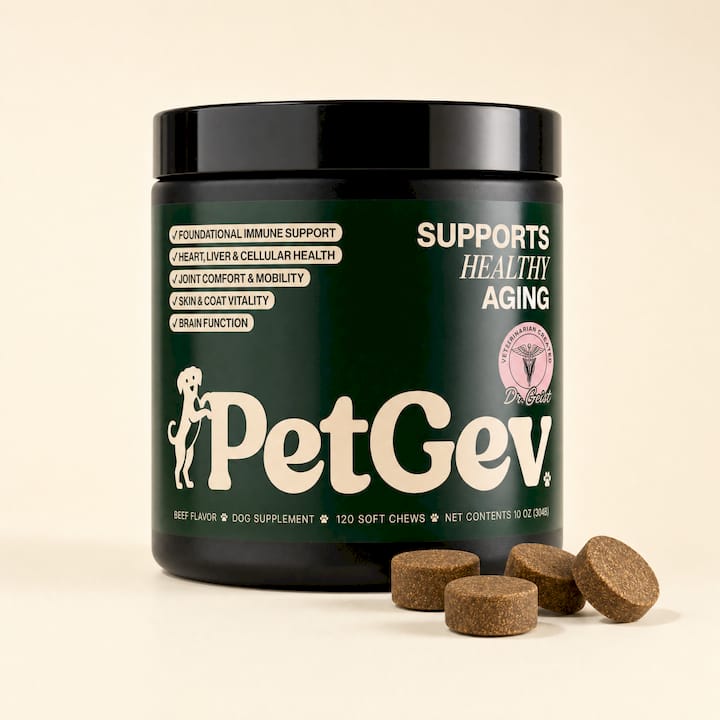
A multi-ingredient chew targets several systems at once instead of just one. That matters because joint discomfort in older dogs rarely shows up alone. It tends to travel with lower energy, stiffer mornings, and sometimes a duller coat as inflammation runs higher throughout the body.
A single daily chew built around this idea typically aims to cover:
- Joint cartilage support and lubrication
- Inflammation reduction around stressed joints
- Sustained energy for daily activity
- Immune and skin/coat support tied to overall inflammatory load
The convenience angle is not a minor detail. Giving a dog seven pills at breakfast is a routine that falls apart fast, especially with a picky eater or a multi-dog household. A single palatable chew that folds several of those ingredients into one dose is simply easier to stick with every day, and consistency is the variable that determines whether any joint supplement actually works.
What Does the Research Say About Mobility Chew Ingredients?
The ingredient list matters more than the marketing copy, and the clinical trial data on a handful of specific compounds is genuinely strong. A randomized, double-blind, placebo-controlled cross-over study found that dogs given undenatured type II collagen (UC-II) combined with Boswellia serrata showed owner-reported LOAD score improvements of about 20% within 4 weeks, with gains becoming clinically meaningful by week 8.
Owner-reported mobility scores improved within 4 weeks in a randomized trial of UC-II and Boswellia, with clinically meaningful changes by week 8.
That timeline lines up with a separate multicenter trial of a soft-chew formula combining eggshell membrane, krill-derived omega-3s, hyaluronic acid, and Boswellia. Researchers tracked dogs using two validated instruments, the Canine Brief Pain Inventory (CBPI) and the Liverpool Osteoarthritis in Dogs (LOAD) scale, and found significant improvements in both over a 90-day period, with some owners noticing changes as early as day 7.
Omega-3 fatty acids deserve their own mention because they carry the most consistent evidence base of any joint ingredient. Cornell University’s College of Veterinary Medicine points to fish oil as the supplement with the strongest research support, citing a common dosing guideline of roughly one teaspoon per 20 pounds of ideal body weight. Curcumin derivatives are catching up fast: a trial using turmerosaccharides extract from Curcuma longa found measurable joint mobility improvements beginning around day 21 and continuing through day 42.
Here’s the pattern worth remembering:
- Owner-reported comfort often improves first, sometimes within a week or two
- Objective, clinically meaningful gains generally show up between 8 and 12 weeks
- Ingredients work better in combination than alone, which is why single-compound supplements tend to underdeliver compared to multi-ingredient chews
How Do You Start a Mobility Chew the Right Way?
Jumping straight to “give one chew a day and hope” wastes the first month, which is exactly when early signals show up. A little structure at the start makes it much easier to tell whether the chew is actually working.
- Establish a baseline before day one. Note how your dog gets up from lying down, whether they hesitate on stairs, and how far they walk before slowing down.
- Pick a start date and stick to a fixed time. Morning with breakfast tends to work best for adherence.
- Expect a loading phase of 4 to 8 weeks. Most trial data shows early signals around week 4 and clearer changes by week 8, so don’t judge results at week two.
- Log progress weekly. A short phone video of your dog walking, plus a one-line note (“hesitated less on stairs today”), builds a simple record you can compare month to month.
- Layer in gentle activity and weight control. A chew supports the joint from within; it doesn’t offset the mechanical stress of extra pounds or replace movement entirely.
- Check in with your veterinarian at the 8-week mark, especially if your dog is on other medications.
Pro Tip: Keep your weekly video log on your phone in the same short walking route each time. Side-by-side comparison over 8 weeks shows changes your memory alone will miss.
Who Should Use a Mobility Chew, and Who Should Check With a Vet First?
Senior dogs, dogs carrying a few extra pounds, and dogs with mild to moderate osteoarthritis tend to be the best candidates for a daily mobility chew. These are exactly the profiles studied in the clinical trials behind ingredients like UC-II, Boswellia, and eggshell membrane.
A few groups need a veterinary conversation before starting, not after:
- Dogs with a known shellfish allergy, since green-lipped mussel and some omega-3 sources derive from shellfish
- Dogs already on NSAIDs or other prescription joint medications, since combining anti-inflammatory ingredients can occasionally overlap effects
- Dogs with liver or kidney disease, where any new daily supplement warrants a vet’s input on dosing
- Puppies and pregnant or nursing dogs, which fall outside the population these trials studied
If you notice loose stool, unusual itching, or lethargy after starting a new chew, stop and call your vet. The NASC Quality Seal is one practical way to screen for manufacturing oversight, since supplement regulation is looser than for pharmaceuticals.
Why Petgev Built a Multi-Ingredient Chew Instead of a Single Supplement
Petgev’s chews were built around a simple observation: dogs rarely have just one aging-related issue, so a formula that only addresses joints leaves other problems unattended. Petgev offers veterinarian-formulated daily chews designed specifically to support healthy aging, and each one packs 14 premium ingredients covering joint mobility, heart function, energy, and immune health in a single dose.
That design replaces up to seven separate products with one chew a dog actually wants to eat. The research behind the formulas draws on the same categories of ingredients validated in the clinical trials above: joint compounds, anti-inflammatory botanicals, and omega-3 sources, combined rather than sold piecemeal.
This section reflects Petgev’s published formulation approach. Independent case studies and third-party clinical trial data specific to Petgev’s exact formula are not yet publicly available.
What Types of Movement Pair Well With a Mobility Chew?
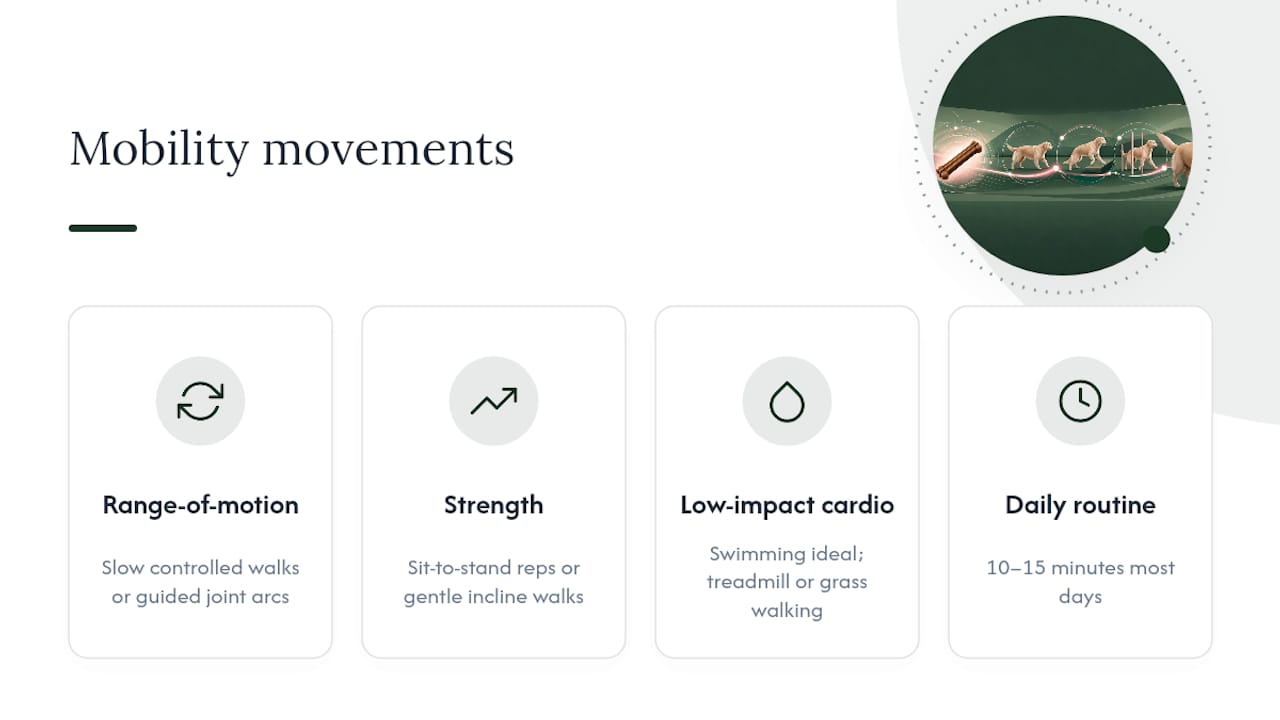
Nutrition support works best alongside movement that respects an aging joint, not movement that stresses it. Three categories cover most of what a senior dog needs.
Range-of-motion work keeps joints from stiffening between activity bouts. Slow, controlled leash walks on flat ground, or gently guiding a hip or shoulder through its natural arc during a calm moment, keep cartilage surfaces lubricated without impact.
Strength-building activity matters more than most owners realize, because the muscles around a joint absorb stress the joint itself can no longer handle alone. Short sessions of sit-to-stand repetitions, or walking up a gentle incline, build the stabilizing muscle that protects hips and knees.
Low-impact aerobic activity keeps weight controlled and circulation strong without pounding on joints. Swimming is the gold standard here since water supports body weight while the dog still works its legs. Where swimming isn’t available, slow treadmill walking or soft-surface walking on grass beats pavement or gravel.
None of this needs to be elaborate. Ten to fifteen minutes of purposeful, low-impact movement most days, combined with consistent nutritional support, tends to outperform occasional long walks followed by days of rest.
How Do You Know If Your Dog’s Mobility Needs Help?
Most owners underestimate how gradually mobility declines, because dogs adapt quietly and owners see their dog every day. A few concrete checks cut through that blind spot.
Watch how your dog rises from a lying position. A healthy dog pushes up in one fluid motion; a dog with joint discomfort often rocks forward, hesitates, or uses the front legs to drag the back half up first. Watch stairs, too. Skipping steps, pausing halfway, or refusing to go up or down at all are common early signals.
Compare current activity to six months ago. A dog who used to trot to the door and now walks, or who used to jump into the car and now waits to be lifted, is telling you something even without limping. Track how long it takes your dog to “warm up” after resting. Stiffness that eases after five minutes of walking is a classic early osteoarthritis pattern.
Writing these observations down before starting any supplement or exercise routine gives you a real baseline. Without it, subtle month-over-month improvement is nearly impossible to notice, which is exactly why the tracking step in the how-to section above isn’t optional.
What Warning Signs Mean You Should Stop and Reassess?
Gentle exercise should never make a dog visibly worse. A handful of signs separate normal effort from overexertion in a senior dog.
- Limping that appears during or right after activity, even if it fades with rest, signals the joint took on more than it could handle.
- Excessive panting that doesn’t settle within 10 minutes of stopping points to overexertion, not just normal exercise breathlessness.
- Reluctance to continue or lying down mid-walk is a dog telling you plainly that it has hit its limit.
- Stiffness that’s worse the next morning than it was before the activity means yesterday’s session was too much.
- Licking or chewing at a specific joint after exercise often indicates localized discomfort worth mentioning to your vet.
The safest approach is to end a session while your dog still looks comfortable, not after it starts to struggle. Building duration slowly, in five-minute increments over several weeks, protects joints far better than a single ambitious hike.
Weight and Lifestyle Changes That Multiply a Chew’s Effect
Every extra pound on a dog’s frame adds measurable load to already-stressed joints, and no chew can fully offset that mechanical burden. Keeping a senior dog at a lean body condition score is one of the highest-leverage things an owner can control directly, and it works in tandem with, not instead of, nutritional support.
A few lifestyle adjustments compound the benefit. Orthopedic bedding takes pressure off hips and shoulders overnight. Non-slip rugs or runners on hardwood and tile floors prevent the slips that often trigger acute flare-ups in already-stiff joints. Raised food and water bowls reduce neck and shoulder strain for dogs with spinal or shoulder discomfort. Ramps or steps for the couch, bed, or car spare joints from repeated jarring impact that adds up over months.
None of these changes require much money or effort, but together they reduce the daily wear a joint experiences, which means the ingredients in a mobility chew have less damage to work against and more room to show a visible effect.
What the Evidence Actually Supports, and Where Owners Get It Wrong
The biggest misconception is that a mobility chew works like a switch: give it, wait a week, expect a transformed dog. The clinical trial data doesn’t support that. Real improvement curves start with owner-noticed comfort around week 4 and build to measurable gains by week 8 to 12. Owners who quit at week two because “nothing changed” are stopping right before the data says results typically appear.
The second mistake is treating supplements and exercise as competing strategies instead of partners. Nutrition addresses inflammation and cartilage health from within; movement builds the muscle that protects the joint mechanically. Neither one substitutes for the other, and the strongest outcomes in the research come from combining ingredient categories, not from betting everything on one compound.
What should come first? A baseline. Before adding any chew or changing any routine, write down exactly how your dog moves today. That single habit, more than any specific ingredient, determines whether you’ll actually recognize progress when it happens.
— Eden
How to Try Petgev’s Chews Without Overcomplicating It
Some daily chews combine joint, heart, energy, and immune support into one treat instead of using multiple separate supplements, offering a simplified routine for senior dog care.
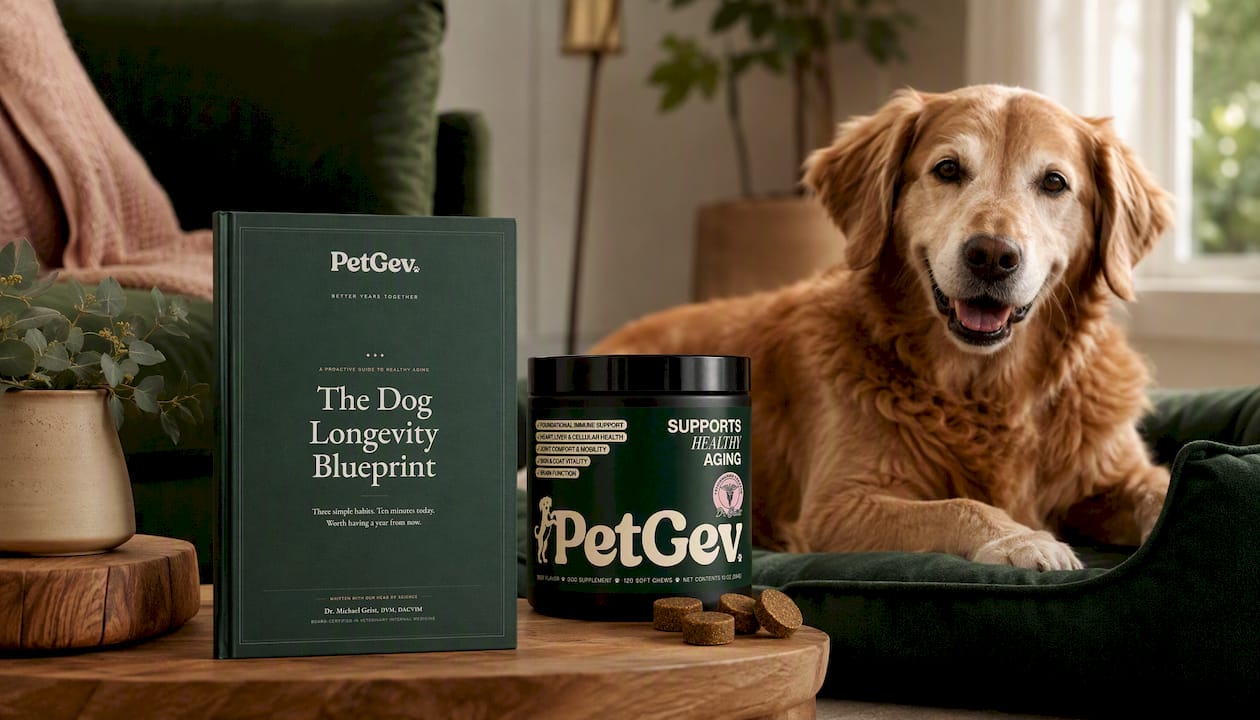
Getting started only takes a few decisions. Pick your product: Healthy Aging Chews for daily multi-system support, or the Dog Longevity Blueprint if you want a broader, structured approach to long-term wellness. Set a daily reminder tied to a meal so the chew becomes part of an existing routine rather than one more thing to remember. Write down your dog’s baseline mobility this week, before the first dose. Then commit to a full 8 weeks before judging results, since that’s the window the clinical data points to for meaningful change.
Recurring shipments can help maintain consistent daily use, which is important given the emphasis on consistency in clinical research. Curious about what’s actually in the formula and why? The ingredient research page breaks down each component’s role.
Sources
- Effects of a feed supplement, containing undenatured type II collagen (UC II®) and Boswellia Serrata, in the management of mild/moderate mobility disorders in dogs: A randomized, double-blind, placebo controlled, cross-over study | PLOS One
- Efficacy of a joint supplement containing eggshell membrane among other ingredients to improve the mobility of dogs with osteoarthritis | Frontiers
- How joint supplements can help with orthopedic conditions | Cornell University College of Veterinary Medicine
FAQ
How Long Before a Mobility Chew Shows Results?
Owner-reported comfort often improves within 4 weeks, with clinically meaningful mobility gains typically appearing between 8 and 12 weeks of consistent daily use.
Can Mobility Chews Replace Exercise or Veterinary Care?
No. Chews support joint health nutritionally, but they work best alongside gentle movement, weight management, and regular veterinary checkups, not as a standalone fix.
Are Mobility Chews Safe With NSAIDs or Other Medications?
Most joint-support ingredients are compatible with common medications, but any dog already on NSAIDs or prescription joint drugs should start a new chew only after checking with a veterinarian.
What Ingredients Should I Look for in a Mobility Chew?
Look for undenatured type II collagen (UC-II), Boswellia serrata, omega-3 fatty acids, eggshell membrane, and curcumin derivatives like turmerosaccharides, since these have the most direct clinical trial support.
Does Petgev’s Chew Cover Joint Support Alone?
No. Petgev’s chews combine 14 ingredients targeting joint mobility, heart function, energy, and immune health in one daily treat, rather than isolating a single benefit.
